
Saturday 29th June 2024
Modest Mussorgsky (1839-1881) Pictures at an Exhibition (revisited)
Written originally as a Piano suite in 1874, Pictures at an Exhibition describes the impressions a visitor to an art gallery may experience as they view paintings, and the mood they have when walking between exhibits. Mussorgsky depicts 10 pictures by Viktor Hartmann and 5 “promenades” between them.
In Tim Kliphuis’ revisit to the gallery, 4 of the original pictures are included (Gnomus (The Gnome), Bydlo (Cattle), Baba Yaga (The Hut on Hen’s Legs) and The Old Castle) with three of the 5 promenades. In the newly curated gallery imagined here, we have an additional 4 impressions written by Tim Kliphuis and the order of the original movements is a little altered from that normally performed.
The first picture depicted by Mussorgsky and here, Gnomus is now lost, but was described as “A sketch depicting a little gnome, clumsily running with crooked legs” by Russian critic Vladimir Stasov. The music with its varying tempi and abrupt changes is thought to represent the gnome’s movements.
Mussorgsky places Bydlo (Cattle) as the fourth picture, but here we encounter it second. Again, the picture is lost, but we do have Stasov’s description as “A Polish cart on enormous wheels, drawn by oxen.” In this movement, we are supposed to be a stationary observer as the heavy cart approaches, passes and continues on its way.
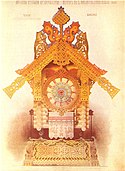
The movement popularly known as Baba Yaga has an original title of: “The Hut on Hen’s Legs (Baba Yaga),” and was the ninth picture in Mussorgsky’s work. This image has survived, and was described by Staslov as, “… a clock in the form of Baba Yaga’s hut on hen’s legs. Mussorgsky added the witch’s flight in a mortar.” In many ways sounding like a more extreme version of Gnomus, the music depicts a chase and the chimes of the clock in a vigorous scherzo.
The second picture in Mussorgsky’s work, The Old Castle, is characterised by Staslov as: “A medieval castle before which a troubadour sings a song” appears fourth here. The artwork is now lost, though thought to be an Italian castle watercolour. This is stylistically a “song without words” reflecting the troubadour that Hartmann was thought to have included in the picture.
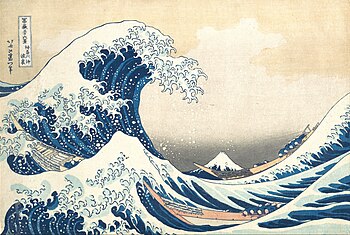
The first of the new interpretations by Tim Kliphuis is of Hokusai’s woodcut print, “The Great Wave off Kanagawa.” This image is reproduced frequently and is undoubtedly the best known of Hokusai’s works. It is the first of a series of 36 woodcuts dating from 1831 in which three boats are tossed by a stormy sea with Mount Fuji in the background.
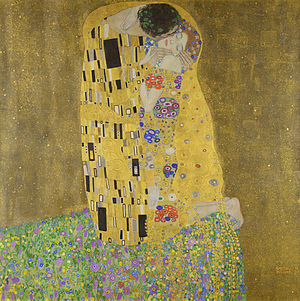
Klimt’s “The Kiss” from 1907 or 1908 is the second painting for which Tim Kliphuis has written a new musical interpretation. Superficially, the subject is of two lovers kissing in a close embrace at the edge of a pasture painted in oils by Klimt with additional platinum, gold and silver leaf to depict gaudy robes and a floral dress in an Art Nouveu style. Some more recent interpretations question if this is love tainted with some degree of male domination, or indeed if this is a representation of Ovid’s Apollo and Daphne. Earlier, it was considered pornographic. It will be interesting to see if any of that informs the new musical interpretation.
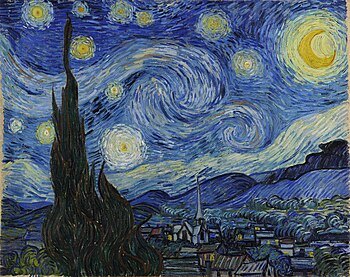
Van Gogh’s “The Starry Night” was painted in 1889 showing a view of the sky just before sunrise with a stylised moon illuminating the landscape below. Van Gough was at that time in an asylum following his mental health crisis that precipitated cutting off his own ear in 1888. The buildings were not present in the view from the asylum – they were created for the picture – but it has been possible to confirm this view as that from his bedroom window.

Painted in 1928 O’Keeffe’s “Ritz Tower” is another night-time image, this time of a skyscraper with moon-lit clouds in the sky as a background and a street light in the foreground. The colours and composition make it hard to imagine it not having been influenced by “The Starry Night.”
This is the last addition to the exhibition that Tim Kliphuis has invited us to walk through and enjoy in this revisited suite.
Django Reinhardt (1910-1953) Selection
Django Reinhardt was a jazz guitarist with a French/Romany heritage. Reinhardt’s European “gypsy jazz” formed the basis of music performed by the Quintette du Hot Club de France with Stéphane Grappelli, and much of it remains familiar, either in its own right or as recognisable influences to later jazz across the US, Europe and beyond.
The strong personality of Reinhardt’s music and improvisational drive of the Tim Kliphuis Trio will surely bring this concert to a lively conclusion!